Shri Shivaji Education Society, Amravati’s,
College of Engineering & Technology, Akola
(Accredited by National Board of Accreditation, India)
N.H.No. 6, At Post : Babulgaon (Jh.), Akola – 444 104.
Maharashtra State, INDIA.
DEPARTMENT OF CHEMICAL ENGINEERING
HOME COURSES-WINTER-SEMESTER WHAT NEW STUDENTS(new) FEEDBACK
SANJAY KRISHNA NAVHALE
M.E. CHEMICAL ENGG.
LECTURER,
DEPARTMENT OF CHEMICAL ENGINEERING
Laxminagar, Mothi Umari, Akola-444005. Maharashtra State, India.
e-mail : [email protected] [email protected]
www.members.fortunecity.com/navhalesk www.geocities.com/navhalesk
Telephone No.+91 (0724) 2428596 [R] 2259024 EXT:35 [O]
CHEMICAL ENGINEERING
Think about career where the opportunities are endless.
What is chemical engineering?
Need of chemical engineering!
Role of chemical engineering in development of society.
Trying not to sound like an advertisement, I'd like to describe some of the more common careers pursued with a Chemical Engineering degree. Firstly, if you're considering studying Chemical Engineering, but you're a little worried, you actually may want to think about it some more!
I've actually heard someone say, "How hard can it be?" Really hard, but really rewarding too! True, the material involved in far from easy and some of the concepts take hours (and in some cases years!) to master, but isn't having this degree worth the effort? I think that you'll find that it will be. I guess what I'm saying is, if you're serious about wanting to be a Chemical Engineer, go for it and don't be afraid to fail (as long as you've done your best). If you're not sure what you want to do, take some preliminary courses first and then ask some of the current students what they think so far and compare you're academic merit to theirs.
Now, once you've got the degree, the fun really starts. I suggest taking the Fundamentals of Engineering Exam (viz GATE) shortly before or after graduation. The after 4 or 5 years of industrial work, you can take the Professional Engineering careers in some for well reputed multinational and national companies. Always a good idea to take these exams, remember, if you don't someone else will and they'll probably get your job!
Speaking of jobs,
What kind of work can you do with a Chemical Engineering degree?
"I love designing equipment, optimizing processes, and
performing financial analyses on these processes."
--DESIGN ENGINEER
"I like to analyze existing
processes and suggest changes needed to increase profitability"
--PROCESS ENGINEER
"I really like designing and
performing experiments to test theories and check the economic impact of plant
changes on a small scale"
--RESEARCH AND DEVELOPMENT ENGINEER
"I'm a people person and I don't
like being trapped in one place all of the time"
--FIELD ENGINEER OR TECHNICAL SALES PERSONNEL
"I want to be a physician"
--MEDICAL SCHOOLS REALLY LIKE CHEMICAL ENGINEERS
7SCET3 PROCESS DYNAMICS AND CONTROL
The subject is an introduction to the science measurement and control of process parameters. The automatic control systems have been rapidly developing in every field of engineering. The subject serves the knowledge of theoretical aspects and the application of control system covering very wide range from different types of control system to the design of various system [first and second order] and controllers
With the growth of continuous manufacturing, the need for continuous measurement of various process variables like temperature, pressure, level, flow, density, viscosity, composition etc. and control them within required range becomes urgent in order to get better quality and economics of the process.
OBJECTIVE:
1] Understanding the science of measurement of parameters and controlling the same automatically.
2] Understanding the basics principle fundamental concept of process control for smooth functioning of industrial process.
3] Understanding the classical techniques for mathematical analysis in detail for design and operation purpose.
4] Understanding the mechanisms of different controller and control valve often encounter in chemical processes.
5] Understanding the effects of the various feedback controllers and the selection of the appropriate controllers.
6] The analysis of stability characteristics and frequency response techniques for tuning of controller used.
PREREQUISITE:
The student is assumed to be having the knowledge of Laplace calculus, unit operations and complex number. Familiars with the elements of mechanics, thermodynamics and fluid mechanics beyond the elementary knowledge of physics. Understanding the science of measurement for both static and dynamic system for parameters viz. temperature, pressure, level, flow, density, viscosity and composition.
7SCE3 PROCESS DYNAMICS AND CONTROL
TENTATIVE COURSE CONTENT
|
Date |
Lecturer No. |
Topics |
Books Used |
|
|
1 |
Relevance of Process Dynamics and Control to Process Industry |
3 |
|
|
2 |
Laplace Transform, Definition, Examples to Find L. T. For Simple Function Transform of Derivatives, Proof, Solution of Diff. Equation |
2, 3 |
|
|
3 |
Inversion by Partial Fraction, Examples |
2 |
|
|
4 |
Final Value Theorem, Initial Value Theorem, Translation of Transform |
2 |
|
|
5 |
First Order System, Definition, Transfer Function for Various System, Mercury Thermometer |
1,2 |
|
|
7 |
T. F. Mixing Process, Liquid Level Single Tank, Stirred Tank Reactor, Pure Capacitive System |
1 |
|
|
8 |
Forcing Function, Definition, L. T. For Forcing Function Response of First Order System for Unit Step Forcing Function |
1 |
|
|
9 |
Response of First Order System for Impulse, Ramp, and Sinusoidal Change, Examples Based on First Order System |
1, 2 |
|
|
10 |
Multicapcity Control System, Non-Interacting Multicapcity Control System And Its Response to Unit Step Change |
1 |
|
|
11 |
Interacting Multi-Capacity Control System and Its Response |
1 |
|
|
12 |
Second Order System, U-Tube Manometer, Damped Oscillator |
1 |
|
|
13 |
Second Order Step Response Equation for Under Damped Control System and Critically Damped and over damped System |
1 |
|
|
15 |
Impulse Response of Second Order Control System for Under, Critically And Over-Damped System |
1 |
|
|
16 |
Characteristics Of Under Damped Control System and Example Based on Second Order System |
1, 2 |
|
TOTAL HOURS REQUIRED=16 |
|||
UNIT NO.: II
|
Date |
Lecture No. |
Topics |
Books Used |
|
|
1 |
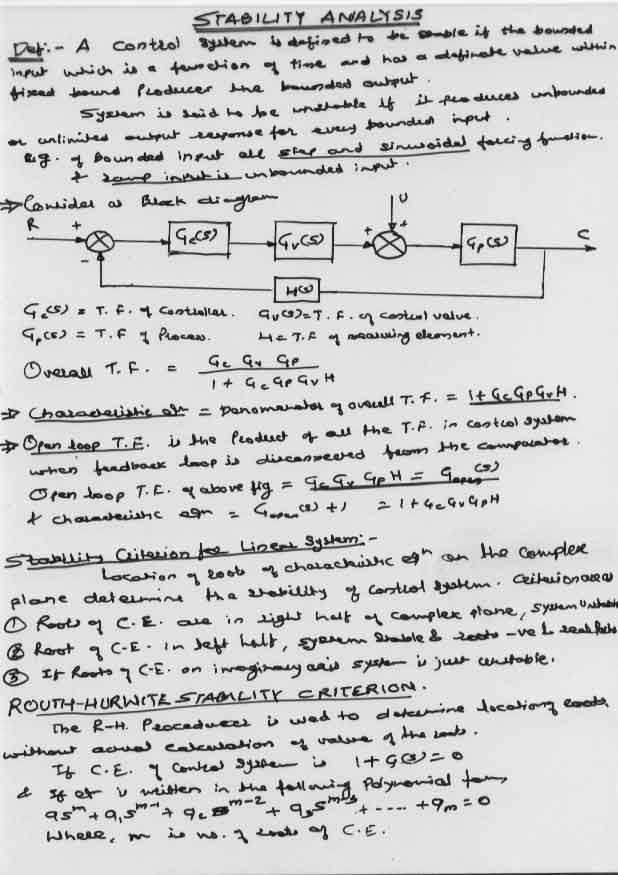
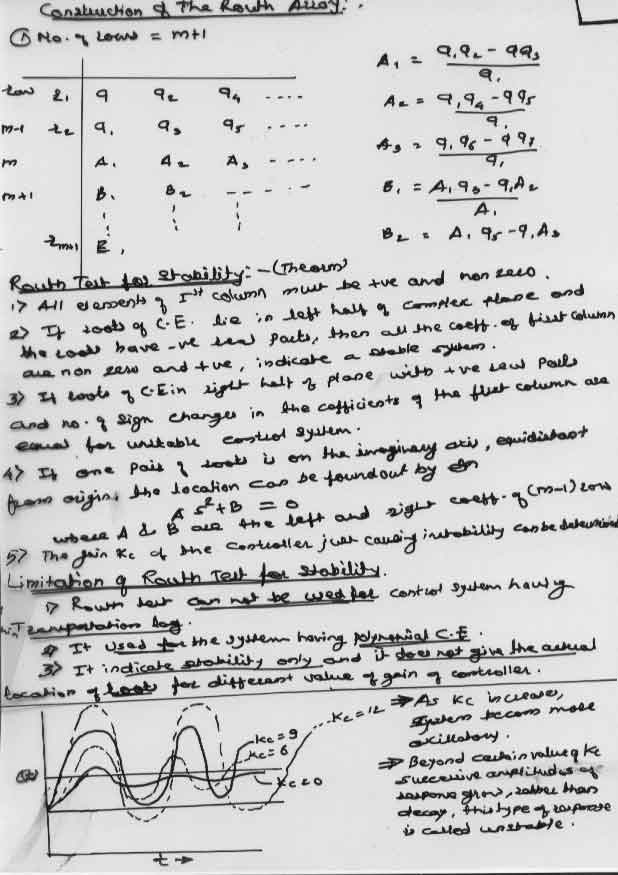
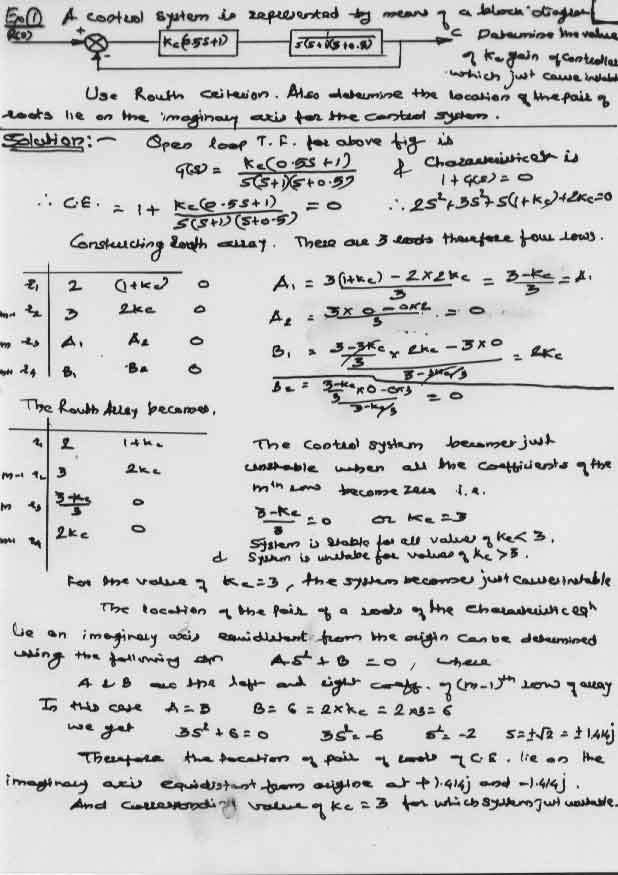
Introduction to Stability, stability for linear system, Routh-Hurwitz stability criterion, Limitations, |
1 |
|
|
2 |
1 |
|
|
|
3 |
1 |
|
|
|
4 |
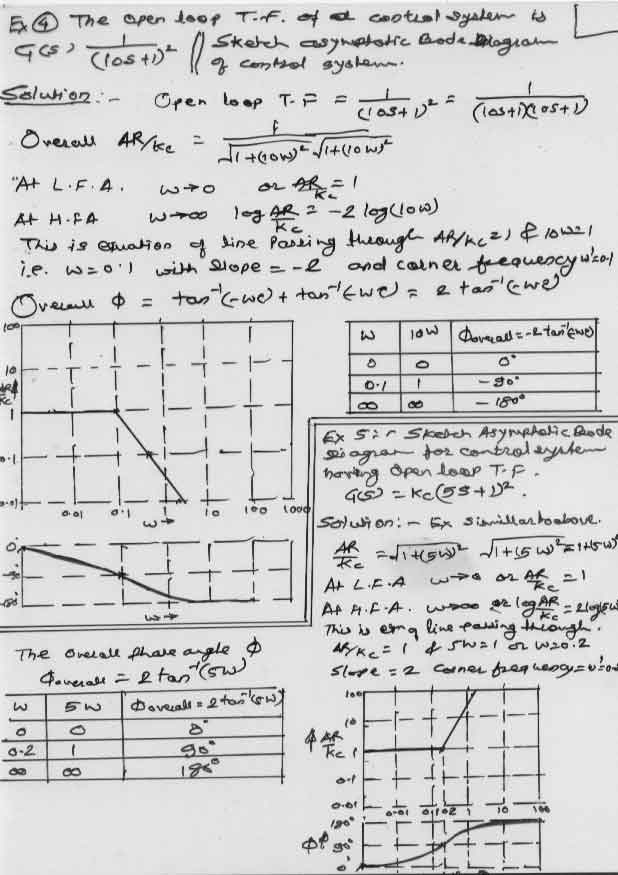
Frequency response, theory, response to first order system Bode diagram, bode plots for first order system, II order system. |
1 |
|
|
5 |
Bode diagram for controllers, the stability criterion, phase and gain margins, Ziegler-Nichols controller setting |
1, 2 |
|
|
6 |
1, 2 |
|
|
|
7 |
1 |
|
|
TOTAL HOURS REQUIRED= 07 |
|||
|
Date |
Lecture No. |
Topics |
Books Used |
|
|
1 |
Process application, control aspects of chemical units, block diagram |
1, 3 |
|
|
2 |
Servo and regulator mechanism, block diagram algebra |
1 |
|
|
3 |
Mechanism of controllers, proportional controller |
1 |
|
|
4 |
Mechanism of PI, PD and PID controller with its transfer function Examples on P, PI, PD, PID controllers |
1 |
|
|
5 |
Function of different modes of controllers, application of controller and comparison of pneumatic and electronic controller |
1 |
|
|
6 |
Dynamic behavior of controller for servo and regulatory control problems for unit step change |
|
|
|
7 |
Dynamics behavior of P, PI, PD and PID controller |
|
|
|
8 |
Examples on dynamics behavior of controllers |
|
|
TOTAL HOURS REQUIRED=08 |
|||
SECTION: B
UNIT NO.: IV
|
Date |
Lecture No. |
Topics |
Books Used |
|
|
1 |
Development of control system, control valve construction and types |
1, 3 |
|
|
2 |
Control valve, pressure to closed and pressure to open valve working of pneumatic control valve |
1 |
|
|
3 |
Dynamics behavior of a Pneumatic control valve |
1, 2 |
|
|
4 |
Application to process industries |
1 |
|
|
5 |
Control valve, Positioner, |
1 |
|
|
6 |
Control of a steam jacketed CSTR, analysis of the process, block diagram |
1 |
|
TOTAL HOURS REQUIRED = 06 |
|||
|
Date |
Lecture No. |
Topics |
Books Used |
|
|
1 |
Advance control techniques, cascade control, block diagram for the system and analysis of the cascade control system and its application |
2, 3 |
|
|
2 |
Feed forward control, analysis of forward control, feedback controller and application |
2, 3 |
|
|
3 |
Ratio control, analysis and block diagram for ratio control, flow control |
2, 3 |
|
|
4 |
Adaptive control |
2, 3 |
|
|
5 |
Digital computer control |
3 |
|
TOTAL HOURS REQUIRED = 05 |
|||
|
Date |
Lecture No. |
Topics |
Books Used |
|
|
1 |
Dynamics and control of chemical equipments temp. Control, application selection of control mode |
3, 2 |
|
|
2 |
Pressure control, applications, control mode, level control and its applications |
3 |
|
|
3 |
Flow rate control, heat exchanger control |
3 |
|
|
4 |
Distillation column control and absorption column control |
3, 1 |
|
|
5 |
Chemical Reactor control |
3, 1 |
|
TOTAL HOURS REQUIRED = 05 |
|||
|
1] Process control and instrumentation; R. P. Vyas; central techno Publications, Nagpur-10; first edition; 2003. 2] Process systems analysis and control; Donald r. Coughanowr; Mcgraw-hill International edition; second edition; 1990 3] Process instrumentation and control; A. P. Kulkarni; Nirali publication; Fifth edition; 1997. |
|||
5SCE(FPOPC)T2 CHEMICAL ENGINEERING
MECHANICAL OPERATIONS (CEMO)
Chemical engineering has to do with industrial process in which raw materials are charged or separated into useful product. Frequently it is necessary to separate the component of mixture into individual fraction. Separating under one class includes methods, called differential separation, which involve phase changes or transfer of material from one phase to another. The second class methods include mechanical separation, which are applicable to heterogeneous mixture, and not to the homogeneous solution. The techniques are based on physical differences between the particles such as size, shape, density or surface properties. Of all shapes and sizes that may be found in solids, the most important from chemical engineering is the small particle. Solids may be broken in many different ways, but only compression, impact, attrition and cutting are commonly used in size reduction machines.
OBJECTIVES:
Understanding the principle/ techniques
1] Mechanical and non mechanical separation of solids form solid.
2] Size reduction of solids particles along with energy requirement.
3] Filtration used for separation of solids from a suspension in liquid.
3] Mixing of liquids in liquids and solids in liquid.
4] Construction and working of conveyor used for transportation of bulk solids.
5] Centrifugation for separation of solid-liquid and liquid-liquid
6] Separation of solids based on surface properties [electric and magnetic] and based on gravity.
PREREQUISITE:
Knowledge of basic fundamentals of engineering and science include general material balance and fundamental laws of science. The knowledge of mathematics will also help while understanding derivation for some equipments or operation.
TENTATIVE COURSE CONTENT
SECTION: A
UNIT NO.: I
|
Date |
Lecturer No. |
Topics |
Books Used |
|
|
1 |
Relevance of Mechanical Operations in Process Industry and It’s Importance. |
3,1 |
|
|
2 |
Introduction to Mechanical Operation and Applications in various Industries. |
3 |
|
|
3 |
Size Reduction, Introduction, Definition, Needs of Size Reduction. |
3 |
|
|
4 |
Principal Modes of Size Reduction, Principal Types of Size Reduction Machines. |
1 |
|
|
5 |
Laws of Crushing and Grinding, Efficiency, Size Reduction Equipments, |
1 |
|
|
6 |
Blake Jaw Crusher, Buhrstone Mill, Fluid Energy Mill |
|
|
|
7 |
Gyratory Crusher, Smooth Roll Crusher, Hammer Mill, |
|
|
|
8 |
Ball Mill, Tumbling Mill, Cutting M/C , Rotary Knife Cutters, Dicers, Slitters |
1,2 |
|
|
9 |
Open And Closed Loop Operation, Examples Based on Laws of Crushing and Grinding, |
1 |
|
|
10 |
Examples on Revolving Mill and Rolling Mill With Formulae Verification |
1,2 |
|
|
11 |
Screening, Separation of Solids From Solids in Dry State, Based on Size, Introduction to Screen and Terms |
1 |
|
|
12 |
Particle Size Measurement and Cumulative & Differential Screen Analysis, |
1 |
|
|
13 |
Screening Equipment, Grizzly, Trommel With Various Arrangement, Vibrating Screen |
1,3 |
|
|
14 |
Screen Effectiveness, Capacity, Variables in Screening Operations |
1,2 |
|
|
|
Total Hours Required = 14 |
|
UNIT NO. :II
|
Date |
Lecture No. |
Topics |
Books Used |
|
|
1 |
Classification, Introduction, Equal Falling Particles, Laws of Classifications |
3 |
|
|
2 |
Equipments, Gravity Settling Chamber, Tabling, Hydraulic Jig |
3 |
|
|
3 |
Gravity Settling, Flow of Solid Through Fluid, Cone Classifiers |
3 |
|
|
4 |
Spitzkasten, Elutriator |
3 |
|
|
5 |
Sedimentation, Introduction, Application, Batch And Continuous Sedimentation |
1,4 |
|
|
6 |
Industrial Sedimentation, Equipments, Thickeners, Dorr Thickener |
1,4 |
|
|
7 |
Examples on Sedimentation |
1 |
|
|
|
Total Hours Required = 07 |
|
UNIT NO. : III
|
Date |
Lecturer No. |
Topics |
Books Used |
|
|
1 |
Nature And Characteristics of Bulk Solids. |
2 |
|
|
2 |
Properties of Particulate Masses, Storage of Solids, Bin Storage. |
2,4 |
|
|
3 |
Introduction to Conveyors, Belt Conveyor |
2 |
|
|
4 |
Chain and Flight Conveyors, Screw Conveyor, Ribbon Conveyor |
2 |
|
|
5 |
Mixing, Introduction, Agitation, Mixing Equipment, Properties of Impellers |
1,2 |
|
|
6 |
Flow Pattern, Standard Turbine Design, Mixing of Solids |
1,2, |
|
|
7 |
Equipment For Mixing of Pastes and Viscous Material, Change Can Mixer, Kneaders, Dispersers and Masticators |
4 |
|
|
8 |
Mixing Rolls, Muller Mixers, Pug Mill |
1,4 |
|
|
9 |
Mixing Index, Power Requirement, Mixing of Dry Powder, Ribbon Mixer, and Tumbling Mill. |
4 |
|
|
|
Total Hours Required = 09 |
|
SECTION: B
UNIT NO. : IV
|
Date |
Lecturer No. |
Topics |
Books Used |
|
|
1 |
Filtration, Introduction, Principle of Filtration, Distribution of Overall Pressure Drop |
1 |
|
|
2 |
Types of Filter Cakes, Types Of Filtration. |
1 |
|
|
3 |
Filter Medium, Filter Aids, Specific Cake Resistance, Equipments For Filtration. |
1 |
|
|
4 |
Gravity Sand Filter, Pressure Filters, Plate And Frame Filter Press. |
1 |
|
|
5 |
Leaf Filter, Moore Filter, Kelly Filter, Rotary Drum Filter, Vacuum Filtration |
1,2 |
|
|
6 |
Examples on Filtration |
2 |
|
|
7 |
Examples on Filtration |
2 |
|
|
8 |
Floatation, Forth Floatation, Introduction, Floatation Agents, Floatation Cell |
3 |
|
|
|
Total Hours Required = 08 |
|
|
|
|||
UNIT NO. : V
|
Date |
Lecture No. |
Topics |
Books Used |
|
|
1 |
Centrifuges, Introduction, Principles of Centrifuge Filtration |
2 |
|
|
2 |
Equipment for Centrifugation, Top/Bottom Suspended Basket Centrifuge |
1 |
|
|
3 |
Examples on Centrifuge Filtration |
2 |
|
|
4 |
Cyclone, Seperation of Solids from Gases, Cyclone Theory, Operation, Hydrocyclone |
2,3 |
|
|
5 |
Scrubber, Electrostatic Seperator, Magnetic Drum Seperator |
1,3 |
|
|
|
Total Hours Required = 05 |
|
UNIT NO. : VI
|
Date |
Lecture No. |
Topics |
Books Used |
|
|
1 |
Adsorption, Introduction, Adsorbent, Adsorption Process |
3 |
|
|
2 |
Types of Isotherm, Types of Adsorption, Nature of Adsorbent |
3 |
|
|
3 |
Industrial Application, Equipment For Adoption |
3,4 |
|
|
4 |
Fixed And Fluidized Bed Adsorption In Industries |
3,4 |
|
|
|
Total Hours Required = 04 |
|
|
Books Actually Used/Recommended : 1] Unit Operations-I; K. A. Gavahne; Nirali Prakashan; Tenth Edition; 2002 2] Unit Operations of Chemical Engineering [Mechanical Operations] Volume-I; R. S. Hiremath/ A. P. Kulkarni; Everest Publication House, Pune; Seventh Edition; 2002. 3] Unit Operation; George Granger Brown; Asia Publishing House; First Edition; 1962. 4] Unit Operations of Chemical Engineering; McCabe and Smith;TMC;1990 |
|||
|
TOTAL HOURS REQUIRE: 47 |
|||
This site was last updated 12/01/05
Home | Courses-Win-Sem | Whats-New | Students | Feedback |